
Manual Insertion Services for PCB Assembly
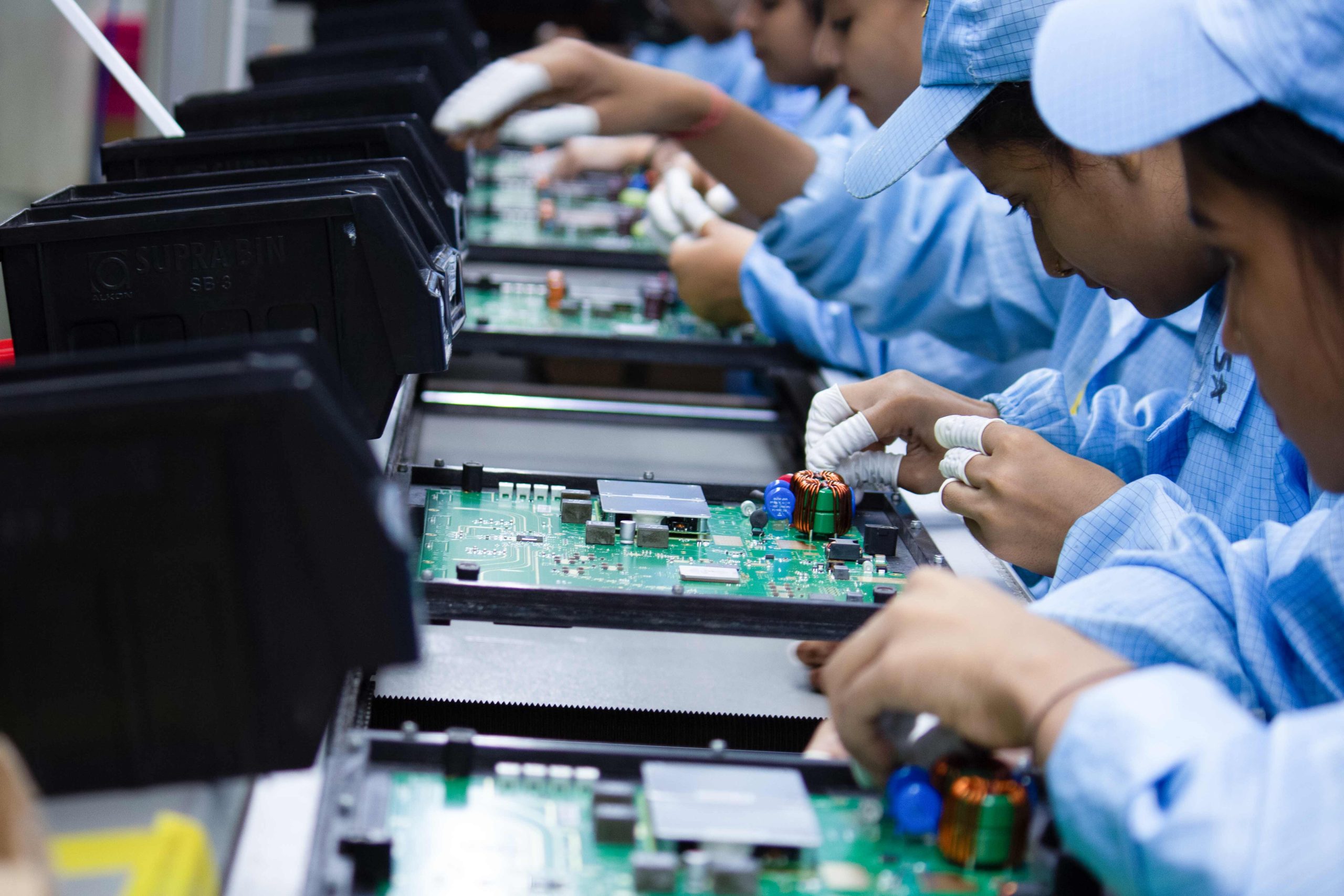
Manual Insertion remains an important part of PCB assembly when certain components, board designs or production requirements are not suited to automated placement alone.
It allows electronic components to be positioned according to the specific assembly requirements of the PCB while maintaining control over placement, orientation and subsequent soldering.
At Optiemus Electronics Limited (OEL), Manual Insertion (MI) forms part of the broader PCBA manufacturing process. Our trained engineering and production teams handle component insertion with attention to placement accuracy, process requirements and quality checks.
When Is Manual Insertion Required?
Not every component is best handled through automated placement. Depending on the PCB design and production requirements, Manual Insertion may be required when:
- A component requires specific manual handling or positioning
- The component form factor or construction makes automated insertion unsuitable
- The PCB design includes through-hole components requiring manual placement
- The production process specifies manual insertion as part of the assembly SOP
- A particular component or board configuration requires additional operator attention
Manual Insertion can therefore work alongside automated PCB assembly. A board may use automated processes for components that are suitable for machine placement while using Manual Insertion for components that require a different handling approach.
This combination allows the assembly process to be selected according to the requirements of the PCB rather than forcing every component through the same production method.
What Is Manual Insertion in PCB Assembly?
Manual Insertion is the process of placing electronic components into their designated positions on a printed circuit board by hand. It is commonly used for through-hole components and for assemblies where component characteristics, PCB design or process requirements make manual handling appropriate.
The requirement for Manual Insertion can arise from the component, PCB design or manufacturing process specified for a particular assembly. OEL's existing manufacturing process also identifies cases where the process SOP or uniqueness of the PCB design requires manual insertion.
This makes Manual Insertion particularly relevant to PCBs that combine different assembly technologies.
Manual Insertion and Through-Hole PCB Assembly
Manual Insertion can be used in through-hole PCB assembly, where component leads are inserted through holes in the PCB before soldering.
Through-hole technology continues to be used for components where the mechanical connection, component construction or board design makes through-hole assembly appropriate. For a mixed-technology PCB, the manufacturing flow may include automated Surface Mount Technology (SMT) placement for surface-mounted components followed by manual insertion of selected through-hole components.
This approach allows different component types and assembly requirements to be accommodated within the same PCBA manufacturing process.
Our Manual Insertion Process
At OEL, the Manual Insertion process focuses on controlled component placement and verification throughout the assembly stage.
-
01
Component Identification
Components are identified according to the PCB design and production requirements before insertion.
-
02
Manual Component Placement
Trained operators carefully place the required components into their designated positions on the PCB. Attention is given to correct component placement and orientation.
-
03
Placement Verification
The inserted components are checked to ensure that they correspond with the required PCB assembly configuration.
-
04
Soldering
Following component insertion, the assembly proceeds through the applicable soldering process. OEL's MI infrastructure includes dedicated wave soldering capability to support the process.
-
05
Inspection and Quality Checks
The assembled boards are checked for component placement and soldering issues. Quality checks form part of the manufacturing process to identify and address assembly issues before the board moves further through production.
At OEL, component placement and soldering are checked as part of the manufacturing process, helping maintain consistency during manual PCB assembly.
OEL's Manual Insertion Capability
OEL has dedicated Manual Insertion infrastructure to support production at scale.
- Manual Insertion lines
- 4
- Component insertions per hour, per line
- 25,000+
- Combined component insertions per day
- 2 lakh+
- Wave soldering machines
- 4
OEL's MI infrastructure includes four manual insertion lines, with each line capable of handling more than 25,000 component insertions per hour. The infrastructure supports a combined capability of more than 2 lakh component insertions per day, supported by a dedicated workforce of engineers, skilled workers and component testers.
The MI setup is complemented by four wave soldering machines, each equipped with an ultrasonic fluxer unit.
These capabilities allow Manual Insertion to function as an integrated part of OEL's PCB assembly process rather than as an isolated operation.
Quality Control in Manual PCB Assembly
Manual Insertion requires consistent process control because component placement directly affects the subsequent soldering and assembly stages.
At OEL, the process includes verification of component placement and checks for soldering issues. This supports consistency across the assembly process while allowing operators and engineers to address issues that require human inspection and intervention.
Manual Insertion as Part of Complete PCBA Manufacturing
Manual Insertion is one part of a broader PCB assembly workflow.
Depending on the product and its assembly requirements, PCBs can involve a combination of automated and manual processes. SMT can be used for suitable surface-mounted components, while Manual Insertion can handle selected through-hole or other components requiring manual placement.
This combination is particularly relevant for mixed-technology PCBs, where different component types require different assembly methods. Other stages of electronics manufacturing can then follow according to the product's production requirements.
For OEL, Manual Insertion therefore forms part of an integrated electronics manufacturing services capability rather than functioning as a standalone service.
Why Choose OEL for Manual Insertion Services?
OEL combines dedicated MI infrastructure with trained personnel and supporting soldering capability to handle manual component insertion as part of PCB assembly.
- Dedicated Manual Insertion production lines
- High-volume component insertion capability
- Trained engineering and production workforce
- Component placement verification
- Soldering issue checks
- Dedicated wave soldering infrastructure
- Integration with broader PCBA manufacturing processes
The result is a manufacturing approach that combines automation where it is appropriate with skilled manual assembly where the PCB or component requirements call for it.
Frequently Asked Questions
What is Manual Insertion in PCB assembly?
Manual Insertion is the process of placing electronic components into their designated positions on a PCB by hand. It is commonly used for through-hole components and assemblies where manual handling is required.
What is Manual PCB Assembly?
Manual PCB assembly involves using trained operators to perform specific component placement or assembly operations that cannot, or should not, be handled entirely through automated equipment.
Is Manual Insertion the same as Through-Hole Assembly?
Not exactly. Manual Insertion describes the method of placing components, while through-hole assembly describes an assembly technology in which component leads pass through holes in the PCB. Manual Insertion can be one part of a through-hole assembly process.
Why is Manual Insertion used when automated assembly is available?
Some components, PCB designs or production requirements are not suitable for automated placement. Manual Insertion provides the flexibility to handle these requirements while allowing the rest of the PCB to use automated assembly processes where appropriate.
Can Manual Insertion be used with SMT assembly?
Yes. A PCB can combine SMT and Manual Insertion as part of a mixed-technology assembly process. Surface-mounted components can be placed using SMT equipment while selected through-hole or other components can be inserted manually.
Does OEL provide Manual Insertion Services?
Yes. OEL has dedicated Manual Insertion infrastructure, including four MI lines and supporting wave soldering capability. Each MI line has a stated capacity of more than 25,000 component insertions per hour.
Discuss Your PCB Assembly Requirement
If your PCB requires manual component insertion, through-hole assembly or a combination of automated and manual assembly processes, OEL can support the requirement through its dedicated MI infrastructure and broader electronics manufacturing capabilities.
Discuss Your PCB Assembly Requirement