
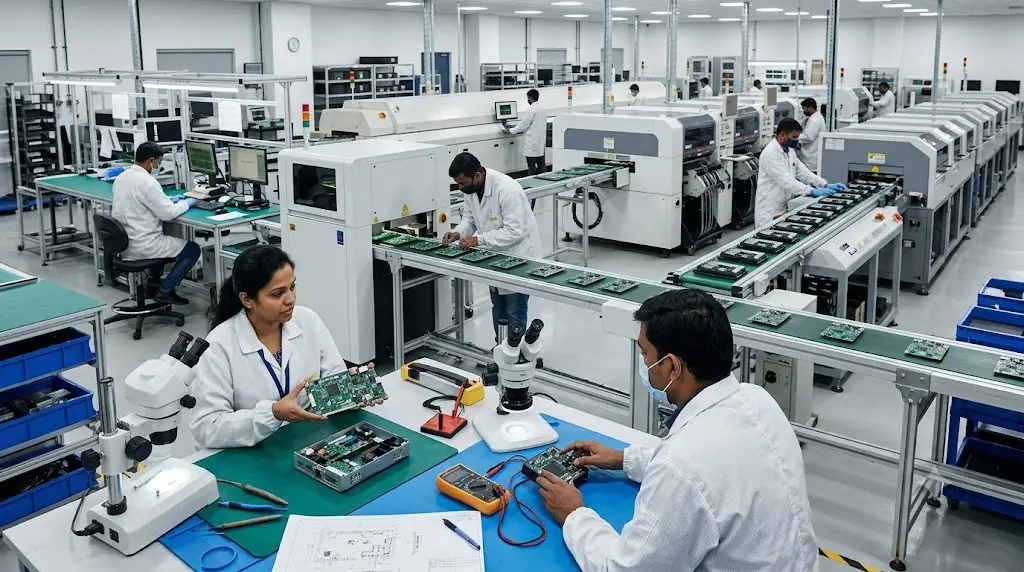
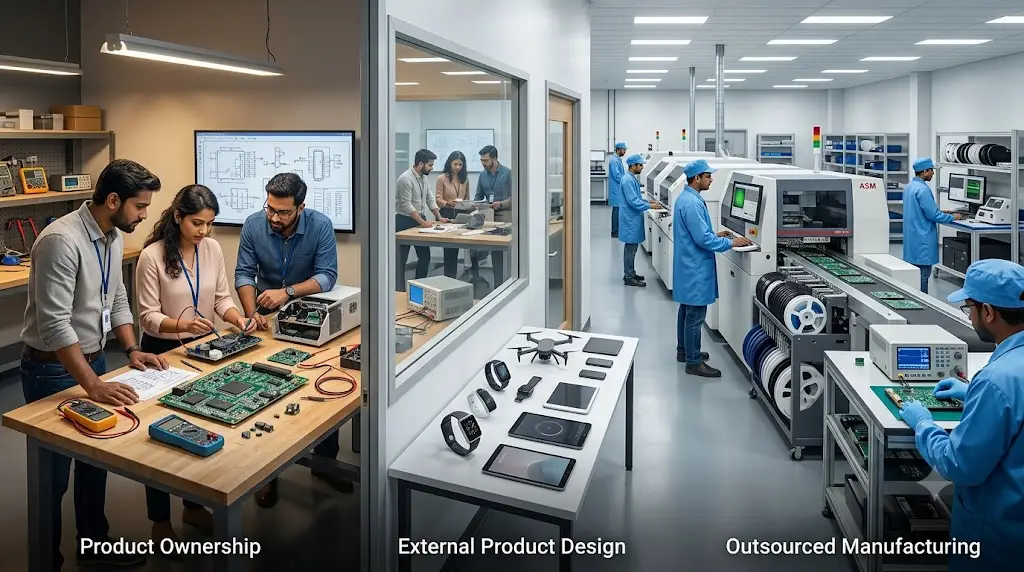
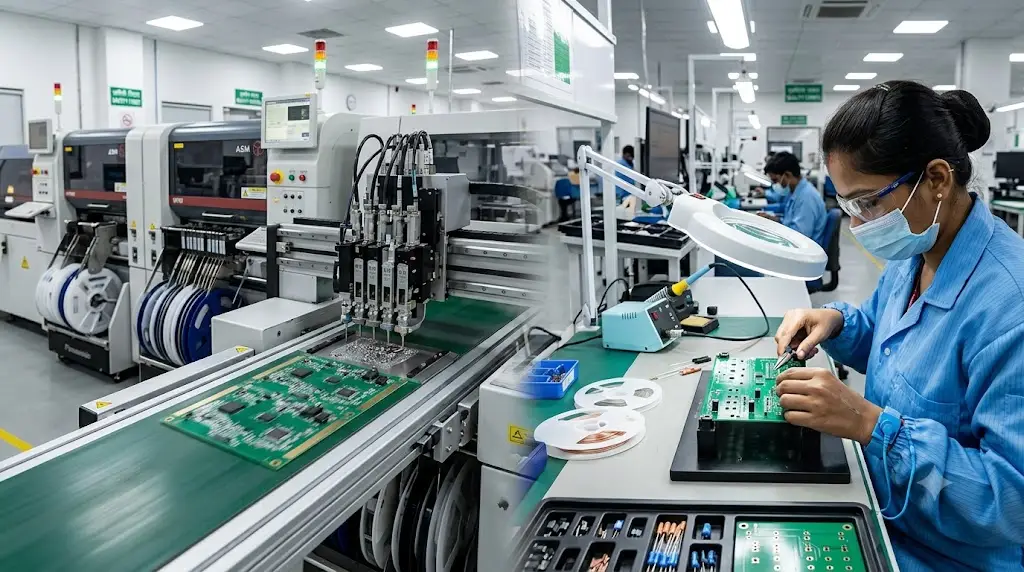
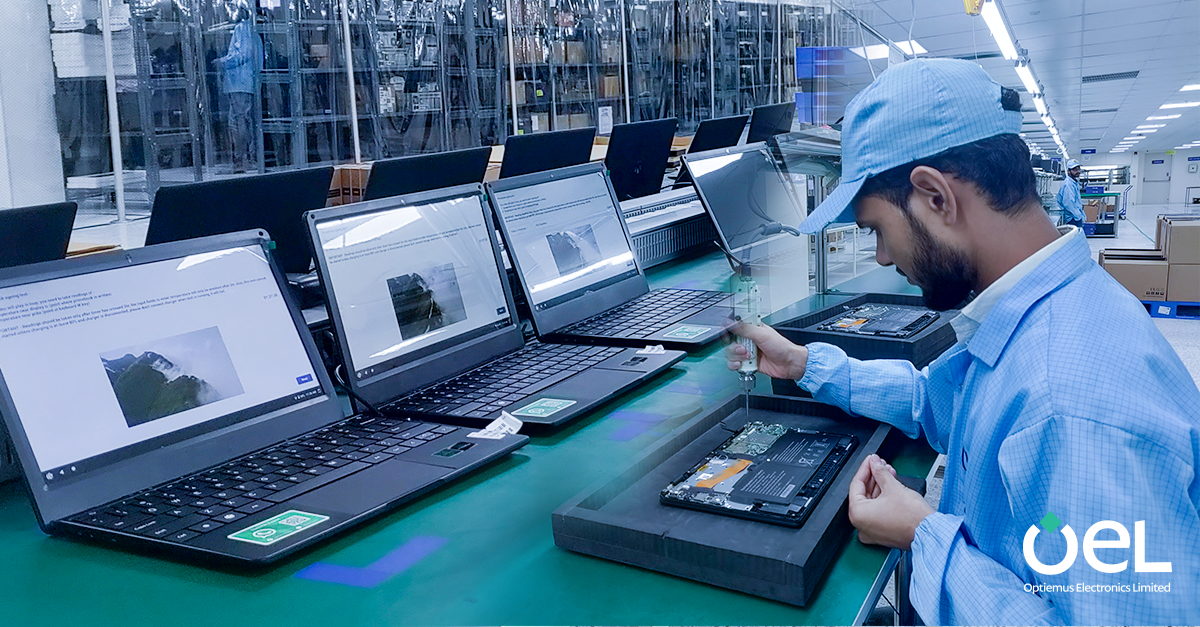
India’s electronics manufacturing industry has moved into a different phase of growth. The conversation is no longer limited to assembling finished devices for domestic demand. The country is increasingly building an ecosystem that spans mobile phones, IT hardware, telecom equipment, electronic components, printed circuit boards, sub-assemblies and the machinery required to manufacture them.
For original equipment manufacturers (OEMs), that shift matters. India is becoming relevant not only as a large end market, but also as a manufacturing and export base that can form part of a broader global supply-chain strategy.
Government data for FY2025-26 shows electronics production in India at approximately ₹13.11 lakh crore, compared with around ₹1.9 lakh crore in 2014-15. Electronics exports reached approximately ₹4.24 lakh crore during the same period. The policy focus is now moving deeper into the value chain through initiatives such as the Production Linked Incentive (PLI) schemes and the Electronics Components Manufacturing Scheme (ECMS).
Data note: Industry and policy figures in this article are based on public Ministry of Electronics and Information Technology (MeitY) and Press Information Bureau updates available through August 2026.
Where Does India’s Electronics Manufacturing Industry Stand in 2026?
The scale of India’s electronics manufacturing expansion becomes clearer when production and export figures are viewed together.
| Indicator | FY2014-15 | FY2025-26 |
| Electronics production | ~₹1.9 lakh crore | ~₹13.11 lakh crore |
| Electronics exports | ~₹38,000 crore | ~₹4.24 lakh crore |
| Mobile phone production | ~₹18,000 crore | ~₹6.27 lakh crore |
| Mobile phone exports | ~₹1,500 crore | ~₹2.59 lakh crore |
Mobile phones have been the most visible success story. India is now the world’s second-largest mobile phone manufacturer by volume, while mobile phones became the country’s largest individual export commodity in FY2025-26.
However, the next stage of the electronics manufacturing industry in India is broader than smartphones. Manufacturing activity is expanding across IT hardware, telecom products, connected consumer devices and hearables and wearables.
What Is Driving Electronics Manufacturing Growth in India?
No single factor explains India’s manufacturing expansion. It is the combination of market demand, policy incentives, production scale, export growth and a gradually deepening supplier ecosystem that is changing the country’s role in global electronics.
1. Scale Has Expanded Beyond Domestic Consumption
India’s large domestic electronics market remains important, but manufacturing capacity is increasingly connected to exports as well. This changes the commercial case for OEMs considering India.
A manufacturing programme can potentially be designed around both domestic demand and international supply rather than treating India solely as a local-market production base.
The rise in electronics exports from approximately ₹38,000 crore in FY2014-15 to approximately ₹4.24 lakh crore in FY2025-26 demonstrates that this export-oriented manufacturing model is already developing at a meaningful scale.
2. PLI Helped Create Scale in Finished Products
The Production Linked Incentive Scheme for Large Scale Electronics Manufacturing was launched in 2020, with mobile phone manufacturing as a major focus.
According to government data reported through March 2026, the scheme had generated cumulative investment of approximately ₹20,587 crore, production of approximately ₹11.62 lakh crore and exports of approximately ₹6.43 lakh crore.
The significance of PLI is not simply the incentive itself. Large production programmes can create demand for suppliers, component makers, engineering capabilities, testing infrastructure, logistics and manufacturing talent around them.
PLI 2.0 for IT Hardware extends this policy direction into categories such as laptops, tablets and servers. That makes India’s electronics manufacturing opportunity increasingly relevant to OEMs outside the smartphone segment as well.
Why ECMS Is Important for the Next Phase of Electronics Manufacturing
Scaling finished-product assembly is only one part of building a competitive electronics ecosystem. A mature manufacturing base also needs deeper access to components, sub-assemblies, materials and production equipment.
This is the gap the Electronics Components Manufacturing Scheme is intended to address.
ECMS targets areas including:
- Printed Circuit Boards (PCBs)
- Passive components
- Electro-mechanical components
- Camera modules and other sub-assemblies
- Optical transceivers
- Materials used within the electronics value chain
- Capital goods required for electronics manufacturing
As of 17 August 2026, 106 ECMS projects covering 30 products across 15 states had been approved. These projects represented expected investment of ₹69,548 crore, projected production of ₹5,34,101 crore and expected direct employment for 74,628 people.
Importantly, 38 of the approved plants had already commenced manufacturing, while another 16 were in advanced stages of construction or machinery installation.
For OEMs, this development matters because component localisation can influence much more than a product’s country of assembly. A deeper local supplier ecosystem can affect sourcing strategy, lead-time planning, value addition, supply resilience and the ability to scale future product programmes.
PLI vs ECMS: What Is the Difference?
| Area | PLI Schemes | ECMS |
| Primary role | Encourage scale in eligible finished-product manufacturing | Develop deeper electronics component and supply-chain capability |
| Relevant examples | Mobile phones, laptops, tablets and servers under applicable schemes | PCBs, components, sub-assemblies, materials and manufacturing equipment |
| Strategic impact | Supports manufacturing scale and exports | Supports localisation and deeper domestic value chains |
The two approaches therefore complement each other. PLI can help create large-scale demand at the product level, while ECMS can strengthen the upstream ecosystem required to support greater localisation.
What Opportunities Does India’s Manufacturing Growth Create for OEMs?
Build for India and Global Markets
The growth of electronics exports means OEMs evaluating manufacturing in India can consider the country within a broader market strategy. Depending on product economics, supply-chain structure and regulatory requirements, manufacturing programmes may support domestic sales as well as international shipments.
Diversify Manufacturing Footprints
Electronics companies increasingly evaluate manufacturing networks for resilience as well as cost and capacity. India provides another large manufacturing geography that OEMs can evaluate alongside their existing production locations.
That does not mean every product or supply chain should automatically move to India. The stronger approach is to evaluate the product category, bill of materials, supplier availability, expected volumes, engineering requirements and target markets before deciding what should be localised.
Localise in Stages Instead of Trying to Localise Everything at Once
For many OEM programmes, localisation is a journey rather than a single decision.
A product may begin with final assembly using a mix of imported and locally sourced components. As volumes and the supplier base mature, additional sub-assemblies, components, packaging or production processes can potentially move closer to the manufacturing location.
ECMS is particularly relevant to this transition because it focuses on building capability further upstream in the electronics value chain.
Use Manufacturing Partners for More Than Assembly
An OEM entering a new manufacturing geography may need support across manufacturing engineering, PCB assembly, process development, testing, final assembly and production ramp-up.
Working with an experienced electronics manufacturing services partner can therefore be relevant well before high-volume production begins.
The early stages of New Product Introduction (NPI) are particularly important because process readiness, equipment availability, manpower, material planning, testing and line capacity need to be evaluated before a programme moves into stable mass production.
What Should OEMs Evaluate Before Choosing a Manufacturing Partner in India?
Industry growth does not automatically make every manufacturing programme successful. OEMs still need to perform detailed operational and technical due diligence.
Manufacturing Capability for the Specific Product
A factory that is suitable for one electronics category may not automatically be the right environment for another. Equipment, assembly processes, testing requirements, production volumes and product complexity differ substantially between categories.
OEMs should therefore assess actual category experience rather than relying only on broad manufacturing capacity claims.
PCB Assembly and Process Capability
For electronic products, the manufacturing partner’s ability to manage surface-mount assembly, manual insertion where required, inspection and process controls can directly affect production consistency.
Testing and Final Assembly
Manufacturing does not finish when components are placed on a PCB. Products may require functional testing, software flashing, final assembly, inspection and packaging before shipment.
The manufacturing flow should therefore be evaluated as one connected system rather than as isolated production steps.
NPI and Production Ramp-Up
Moving from a sample or prototype to repeatable production requires a different level of manufacturing discipline. OEMs should assess how the partner handles pilot builds, process documentation, material planning, line readiness, risk identification and production ramp-up.
Quality Systems and Traceability
Quality should be built into the manufacturing process rather than treated only as final inspection. OEM teams should understand how incoming materials, in-process production, testing, deviations and finished goods are controlled and documented.
Supply-Chain Readiness
Local assembly alone does not guarantee a resilient supply chain. Component availability, approved vendors, lead times, material substitutions, logistics and inventory planning should form part of the manufacturing assessment.
India’s Next Manufacturing Opportunity Is Deeper Value Creation
The growth of mobile phone assembly demonstrated that India can build electronics manufacturing scale. The next challenge is to broaden that success across more product categories while moving deeper into components, materials, engineering and manufacturing technology.
That is why ECMS is strategically important. Manufacturing more PCBs, sub-assemblies, electro-mechanical components and other inputs locally can gradually make India’s ecosystem more complete.
For OEMs, the opportunity is therefore larger than simply finding another assembly location. It is the possibility of participating in a manufacturing ecosystem that is simultaneously increasing production scale, export capability and localisation.
How OEL Supports Electronics Manufacturing Programmes
Optiemus Electronics Ltd. (OEL) provides end-to-end electronics manufacturing capabilities across sectors including mobile devices, IT hardware, telecom equipment,IoT devices, fintech devices and hearables and wearables.
OEMs evaluating manufacturing programmes can explore OEL’s broader industry capabilities and its dedicated electronics manufacturing services covering the journey from manufacturing processes through final assembly and production scale-up.
For product companies planning manufacturing in India, the important question is not simply whether capacity exists. It is whether the manufacturing partner, processes, supply chain and production roadmap are aligned with the product’s technical and commercial requirements.
Conclusion
The electronics manufacturing industry in India entered 2026 with considerably more scale than it had a decade ago. Electronics production has expanded, exports have grown rapidly, mobile manufacturing has reached global scale and policy attention is increasingly shifting towards components and deeper localisation.
PLI helped accelerate manufacturing of major finished-product categories. ECMS is now focused on strengthening the component ecosystem that sits behind those products.
For OEMs, this creates a broader opportunity: manufacture for a major domestic market, develop export-oriented production, diversify supply chains and progressively increase local value addition as India’s supplier ecosystem develops.
The companies that benefit most from this shift are likely to be those that treat India not simply as an assembly destination, but as part of a long-term product, supply-chain and manufacturing strategy.
Frequently Asked Questions
How large is the electronics manufacturing industry in India in 2026?
According to Government of India data, electronics production reached approximately ₹13.11 lakh crore in FY2025-26, while electronics exports reached approximately ₹4.24 lakh crore.
What is the PLI scheme for electronics manufacturing?
The Production Linked Incentive framework includes schemes designed to encourage eligible electronics manufacturing in India. The Large Scale Electronics Manufacturing scheme has played an important role in mobile-phone manufacturing, while PLI 2.0 supports eligible IT hardware categories such as laptops, tablets and servers.
What is the Electronics Components Manufacturing Scheme?
The Electronics Components Manufacturing Scheme, or ECMS, is a government initiative intended to deepen India’s electronics supply chain by encouraging manufacturing of components, sub-assemblies, materials and capital goods used in electronics production.
Why are global OEMs considering electronics manufacturing in India?
Key factors include India’s large domestic market, growing export base, expanding manufacturing capacity, policy support and the gradual development of a deeper electronics component ecosystem. The suitability of India still needs to be assessed at the individual product and supply-chain level.
What should an OEM check before selecting an electronics manufacturer in India?
OEMs should assess product-specific manufacturing capability, PCB assembly, testing, NPI processes, quality systems, supply-chain readiness, traceability, scalability and the manufacturer’s ability to support the product from pilot production through volume manufacturing.